Listicle Link Building for SaaS: How to Get Featured in "Best Tools" Lists

By Sonam Gour
Published 12 min read
A potential customer is comparing project management software. They open a list of tools for creative teams and scan the options. Is your product relevant to that reader? If so, the list may be worth a thoughtful pitch.
Listicle link building is the process of seeking relevant mentions in articles like these. The useful part is not a promise of another backlink. It is getting your product in front of an audience that has a reason to consider it, while giving the publisher room to make an honest editorial decision.
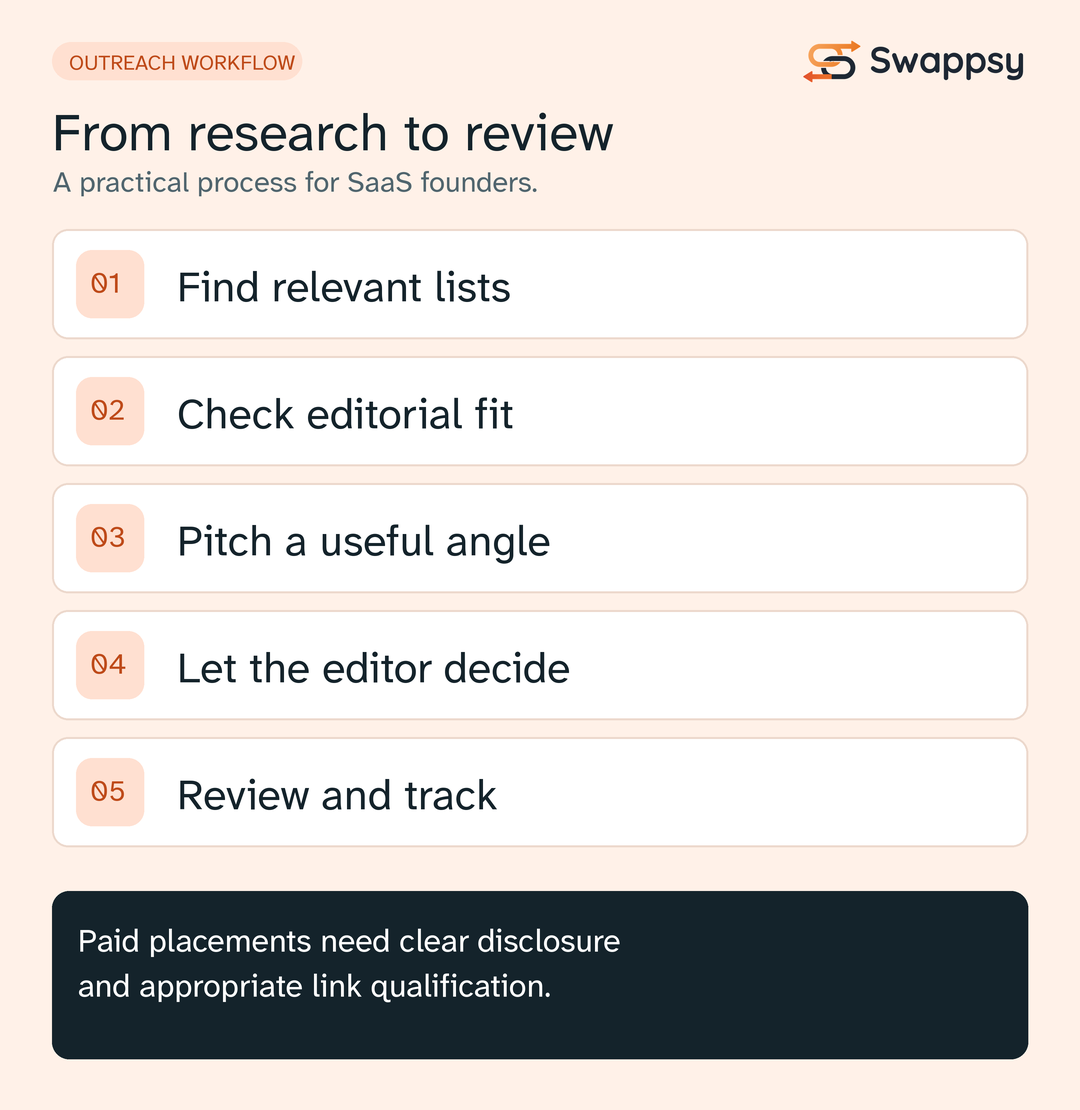
That distinction matters. An independent editor may include your product, decline it, mention it without a link, or write about a limitation. A paid placement is a different arrangement and needs appropriate disclosure and link qualification. Neither approach guarantees rankings or referral traffic.
Here is a practical way to find good opportunities, contact the right people, and recognize offers worth turning down.
What Is Listicle Link Building for SaaS?
A listicle is an article organized as a list. For a SaaS company, that might be a comparison of project management platforms, a roundup of accounting tools for freelancers, or a guide to alternatives to a well-known product.
Listicle link building means identifying lists where your product could genuinely help the reader and seeking consideration for inclusion. A feature may include a link to your site, but the editor controls the decision and the final wording in an independent editorial review.
For the examples in this guide, imagine PlanSprout, a fictional project management product for small creative teams. It combines project boards with a client approval step, but it does not offer budget forecasting. PlanSprout wants to be considered for a fictional article called "Best Project Management Software for Small Creative Teams."
That is a narrower, more useful starting point than asking to appear in every article with the word "software" in the title.
Why SaaS Companies Want to Appear in "Best Tools" Lists
People reading a comparison are often trying to understand which options fit their needs. A relevant inclusion can help them discover a product, learn how it differs from alternatives, and visit its site if they want to investigate further.
It can also give a team feedback about how an outside reviewer understands the product. If the description is unclear or a feature is misunderstood, that is useful information for your own messaging.
A backlink can be one outcome, but it is not proof of business value by itself. A list with a large audience may not send qualified visitors. A small, focused publication may reach exactly the people you serve. Referral visits, signups, and feedback are more informative than a link count alone.
Do not assume a mention will improve search rankings or cause an AI assistant to recommend your product. Those outcomes are not guaranteed.
How to Find Relevant SaaS Listicles
Start with the problems your buyers are trying to solve, then look for publishers already helping those buyers compare options.
Search by category and use case
Try searches such as:
best project management software for creative teamsproject management tools for client approvalsproject management software for small agencies[competitor name] alternatives for agencies
Replace the examples with your actual category, audience, and use case. A broad query can surface established roundups. A more specific one may reveal lists whose readers are a closer fit.
Open the article, not just the search result. Note what it covers, whom it addresses, whether your product is already mentioned, and whether the publisher appears to maintain it. A recent date is a clue to investigate, not proof that a guide was meaningfully updated.
Look at where comparable products appear
Review the public websites and comparison articles that mention products serving a similar audience. You can also use a backlink research tool to discover pages linking to competitors, then inspect each page yourself.
A competitor's presence is a starting point, not proof that your product belongs there. A guide to enterprise portfolio management may mention project tools but still be a poor fit for PlanSprout's small creative teams.
Keep a short prospect record
A simple spreadsheet is enough to start. Record:
- The article title and URL.
- The publisher, intended audience, and a contact or editorial page.
- The reason your product could help readers of that specific list.
- The article's inclusion criteria, if stated, and any disclosure or paid placement terms.
- A decision: pitch, investigate further, or skip.
- The date you contacted the publisher and any response.
For PlanSprout, "compares tools for creative agencies and discusses client approvals" is a useful fit note. "High authority website" is not a substitute for reading the article.
How to Evaluate a Listicle Before Pitching
A list is worth considering when the reader, the product, and the publisher's process make sense together. Use this checklist before you send a message.
- Audience fit: Is the article written for people who might actually use your product?
- Product fit: Does your product meet the needs and criteria the article describes? Be honest about missing features.
- Editorial process: Does the publisher explain how tools are selected, tested, or compared? Can the editor decline or change a submission?
- Useful content: Does the article offer meaningful comparisons, limitations, or evidence, rather than a collection of generic promotional blurbs?
- Publisher identity: Can you identify the publication and an appropriate person or team to contact? Confirm that the person offering a placement is authorized to do so.
- Commercial terms: Are paid spots, affiliate relationships, and other material connections disclosed? If money or another benefit is involved, how will the link be qualified?
- Link patterns: Do outbound links fit the article, or does the site repeatedly publish unrelated commercial links with little context?
- Reach in context: Is there credible evidence that the article reaches your audience? Treat third-party traffic numbers as estimates, not proof of page-level visitors or conversions.
Google's guidance on high-quality reviews encourages publishers to evaluate products from a user's perspective, provide evidence where appropriate, and discuss benefits and drawbacks. Those are useful qualities to look for, even though you may not be able to verify every part of a publisher's process from the outside.
For a closer look at website quality, ownership, and link patterns, use our partner vetting checklist. No checklist, traffic figure, or third-party authority score can guarantee that a placement complies with Google's policies.
Example decisions
- Pitch: A guide for small creative agencies compares client approval workflows, and the editor accepts relevant product suggestions. PlanSprout can explain its fit and limitations.
- Skip: A roundup is for enterprise teams that need budget forecasting. PlanSprout lacks that capability, so the audience is unlikely to be a good match.
- Decline: A publisher offers an undisclosed paid spot with a followed link specifically to improve rankings. The proposed terms conflict with Google's guidance on paid links and undermine reader trust.
- Decline: An unrelated site conditions inclusion on a link back, solely to influence rankings. Neither placement has an independent reason to exist for readers.
- Decline: A publisher insists on claiming that PlanSprout includes budget forecasting after being told that it does not. The resulting listing would mislead readers.
A clearly labeled sponsored opportunity may still be worth evaluating as advertising. It is not the same as independent editorial coverage, and the publisher must qualify any paid link appropriately.
How to Contact Editors and Website Owners
Once you have a shortlist, look for the person or team responsible for the article. The original author may not be the current editor, so check the publication's contact page, contributor guidance, or the article itself before reaching out.
Keep the message specific and easy to assess:
- Name the article and explain the section or reader need you are responding to.
- Describe your product in plain language and identify who it serves.
- Give one concrete reason it might add a useful option to the comparison.
- Mention an important limitation when it affects fit.
- Offer current product information or a walkthrough. Ask for consideration, not a guaranteed placement or a particular link attribute.
Do not send a mass-produced message that pretends you read an article you did not read. Avoid misleading testimonials, copied praise, and demands for a specific ranking position.
If the publisher has no stated follow-up policy, one brief, polite follow-up after about a week is reasonable. If they decline or ask not to be contacted again, respect that decision. These are practical suggestions, not a formula that guarantees a reply.
Keep track of the outcome
If the editor includes your product, check that the description, destination URL, and any disclosure are accurate. Ask politely about factual errors, but do not demand a favorable review or pressure the publisher to remove an appropriate link qualification.
Record the page URL and the date you checked it. If there is a link, you can monitor it for changes while also reviewing the listing itself. Our guide to monitoring backlinks explains a spreadsheet approach and a monitoring tool. A link check cannot tell you whether the description is fair or whether an arrangement complies with policy.
An Example of a Natural SaaS Listicle Outreach Email
The product, publisher, and people below are fictional. The email asks for an independent evaluation and does not offer payment or a link in return.
Subject: A possible fit for your creative team software guide
Hi Maya,
I read your comparison of project management tools for small creative teams. Your point about keeping client feedback out of scattered email threads stood out.
I'm Alex, the founder of PlanSprout. We make project boards with a client approval step for small teams managing creative work. It may be useful to readers who want project tasks and client feedback in one place.
One limitation: PlanSprout does not include budget forecasting, so it may not fit teams that need that feature.
If you update the guide, would you be open to considering it? I'm happy to share a walkthrough and current pricing. Of course, it's your decision whether it belongs in the article.
Thanks for your time,
Alex
The useful details are the audience, a specific product fit, and a real limitation in the fictional scenario. For an actual pitch, replace every example with facts you can support and a detail you genuinely noticed in the publisher's article.
Free Editorial Mentions vs. Paid Placements
These arrangements should not be treated as interchangeable.
Independent editorial consideration
You share information and ask a publisher to evaluate your product. There is no payment or exchange of value for the mention or link, and the editor decides whether and how to cover it. The outcome may be a link, an unlinked mention, a critical comparison, or no inclusion at all.
A standard trial available to the public can help someone evaluate a product. If you offer an exclusive perk or something else of value, consider whether it creates a material connection that should be disclosed. Do not condition access or a benefit on receiving a link.
Paid or otherwise compensated placements
A publisher may sell advertising, sponsored inclusions, or affiliate placements. Paying for visibility can be a legitimate advertising decision, but the arrangement should be clear to readers and the link should be treated appropriately.
Google's link spam policies identify buying links to manipulate rankings, including exchanging goods or services for links, and excessive link exchanges among their examples of link spam. Google prefers rel="sponsored" for paid links and also accepts rel="nofollow". See its outbound link guidance.
For example, a publisher could use this markup for a paid listing:
<a href="https://example.com/" rel="sponsored">PlanSprout</a>
The address above is a placeholder, not a real product link. Link attributes are signals to Google; they are not a substitute for telling readers about a material commercial relationship, and they do not make an otherwise deceptive or manipulative arrangement acceptable.
For US audiences, the FTC's Endorsement Guides on material connections explain that material connections that may affect how consumers evaluate an endorsement should be disclosed clearly and conspicuously when they are not already obvious. Payment, affiliate commissions, or valuable perks can create such a connection. A visible disclosure and an HTML link attribute serve different purposes. Requirements depend on the facts and applicable law, so seek qualified advice when needed.
Do not pay for an undisclosed followed link to improve rankings, or exchange links solely to obtain a listing. Ask about terms before agreeing, and walk away if the publisher refuses appropriate disclosure or link qualification.
Common Listicle Link-Building Mistakes
- Pitching the wrong audience. A broad list is not a good target if its readers need features you do not offer.
- Using authority scores as the only filter. A third-party metric does not establish editorial quality, audience fit, or Google compliance.
- Offering a ranking-driven trade. Do not make your inclusion conditional on adding a link in return or on getting a followed link for SEO benefit.
- Hiding compensation. Paid and affiliate relationships need appropriate link treatment and, where applicable, clear reader-facing disclosure.
- Sending automated mass outreach. Generic messages that ignore the article and its editorial criteria waste attention and can damage relationships.
- Dictating the review. A publisher should be free to assess the product, note limitations, and decline it.
- Treating a placement as a permanent result. Lists change. Check accuracy and links over time, and measure useful outcomes rather than assuming a ranking benefit.
How Swappsy Can Help You Discover Potential Partners
Swappsy is our product. Its link exchange platform helps site owners find potential partners and supports tool and roundup listing deals. In the partner finder, you can search posts by domain or title and filter by post type. A post can show the site's proposed pages, link type, turnaround, and available partner history. See how to find partners and send a request.
There is an important distinction: Swappsy's roundup listing deals are reciprocal arrangements, not the same thing as the independent, no-exchange editorial pitch in the example above. If you want an editor to consider your product without a reciprocal commitment, approach the publisher directly and leave the decision to them.
If you review a potential Swappsy partner, read the actual list and the proposed terms yourself. Google specifically identifies excessive link exchanges and links created primarily to manipulate rankings as link spam. A relevant publisher, a reliable partner record, or a platform verification badge does not by itself make an arrangement compliant. Do not use a reciprocal deal solely to secure a listing or manipulate rankings.
Swappsy can also monitor links from deals and links you add separately. Monitoring can help you notice a change; it cannot guarantee a placement, a ranking result, or compliance with Google's policies.
Frequently Asked Questions
Is listicle link building against Google's guidelines?
Asking an editor to consider a useful product is different from arranging links to manipulate rankings. Google's policies identify paid links that pass ranking credit, excessive link exchanges, and other manipulative arrangements as link spam. Assess the purpose and terms of each opportunity rather than assuming every listing is compliant.
Do I have to pay to be included in a SaaS listicle?
No. Some publishers consider products independently without payment, while others offer paid or affiliate placements. An editor can decline an unpaid pitch. If a placement is compensated, the relationship should be disclosed where required and the link should be appropriately qualified.
Is a sponsored or nofollow link still useful?
It may introduce relevant readers to your product and send referral traffic, but neither outcome is guaranteed. sponsored is Google's preferred attribute for paid links, and nofollow is also accepted. Do not ask a publisher to remove an appropriate qualification to pass ranking credit.
Can I offer free access for a review?
You can explain how an editor can evaluate your product, such as through a trial available to the public. Exclusive free access or other perks may be material connections that require disclosure. Offering a product or service in exchange for a link can also raise Google policy concerns, particularly when the purpose is to manipulate rankings. Do not make a link or positive coverage a condition of access.
How long does it take to get featured?
There is no reliable universal timeline. An editor may be updating a guide now, plan to revisit it later, or decide that your product is not a fit. Track your outreach and respect the publisher's process.
Can a listicle placement guarantee rankings or AI recommendations?
No. A mention or link can help people discover your product, but it does not guarantee a search ranking, referral traffic, or inclusion in an AI-generated answer.
Sources
- Google Search Central: Spam policies, including link spam
- Google Search Central: Qualify outbound links
- Google Search Central: Write high quality reviews
- FTC Endorsement Guides: Disclosure of material connections, 16 CFR 255.5
- Swappsy: Link exchange and roundup listings
- Swappsy: Find partners and send a request