How to Vet Link Exchange Partners: A Practical Checklist (2026)

By Sonam Gour
Published 10 min read
Reviewed October 27, 2026
A site owner offers you a link. Their website looks polished, the traffic number is decent, and they say they can publish this week. Is that enough to say yes?
Not quite. A useful review starts with the actual page, the site's audience, and the person offering the placement. It also asks a separate question: why are the links being created?
Partner reliability and Google policy compliance are not the same thing. A partner can communicate well, publish on time, and keep a link live while the arrangement itself still creates SEO risk. No traffic figure, Domain Rating, verification badge, or checklist can guarantee that an exchange follows Google's policies.
Swappsy is our product, and it helps site owners find partners and track deals. This guide explains what you can check yourself and where a platform's information stops being a substitute for editorial judgment.
The Quick Partner Vetting Checklist
Before you agree to a placement, work through these seven checks:
- Relevance: Does the proposed page serve an audience that would benefit from the link?
- Content quality: Are the site's articles useful, original, and subject to editorial review?
- Traffic: What do the traffic source, leading pages, and recent trends actually show?
- Outbound links: Do existing links make sense in context, or do pages contain unrelated commercial placements?
- Ownership: Can your contact demonstrate access and authority to publish on the site?
- Google policy: Is the arrangement primarily intended to manipulate rankings, or part of an excessive exchange pattern?
- Editorial choice: Would the publisher choose each link independently, even without a trade?
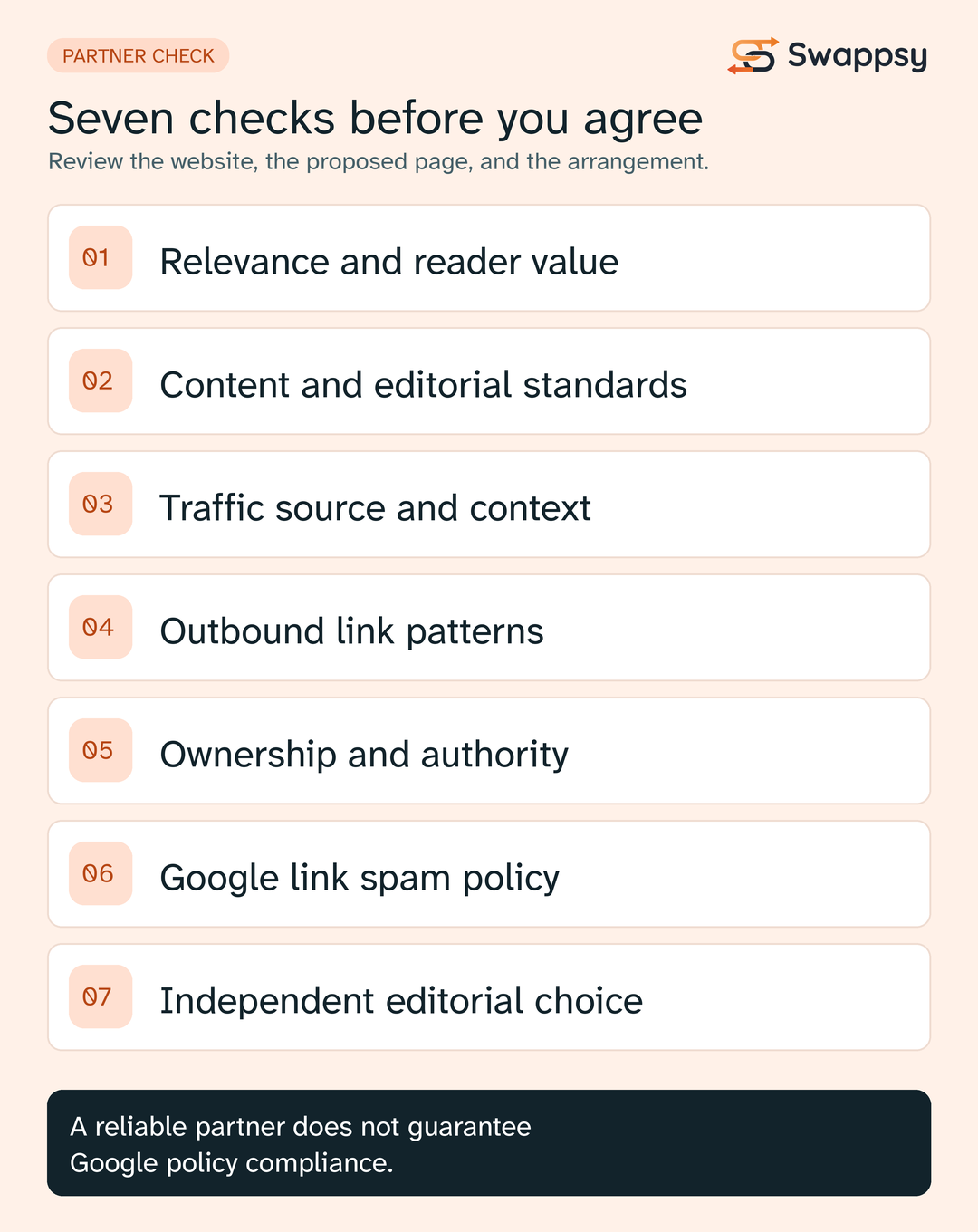
The checklist is a way to organize a decision, not a passing score. If you cannot answer an important question, ask for more information rather than treating it as a pass.
1. Check Topical Relevance and Reader Value
Start with the specific article where the link would appear. A website can be broadly relevant while the proposed page is not.
For example, a payroll software company and an accounting blog may serve the same small business owners. A payroll guide linked from an article about payroll deadlines could be useful. The same link dropped into an unrelated travel article would be harder to justify, even if both articles live on a popular site.
Read the paragraph before and after the suggested link. Ask:
- Does the destination explain something the reader is likely to need at that point?
- Is the link text descriptive of the destination?
- Would the article still make sense if the link were removed?
Relevance is a reason to look more closely, not proof that an arrangement complies with Google's policies. Google's link guidance recommends descriptive, natural anchor text, but good wording alone does not change the purpose of a link. 3
2. Read the Content and Look for Editorial Standards
Open a few recent articles, including the proposed placement page. Do not rely on the homepage or a metric in a directory.
Look for clear authorship or an identifiable publisher, useful information, sources where appropriate, and content that fits the site's stated audience. Ask whether the publisher reviews submissions and can decline or edit a link that does not belong.
A small site can have excellent content. A large site can publish weak pages. Neither a high Domain Rating nor a particular publishing schedule tells you whether an editor makes independent decisions.
Treat a pattern of thin articles built around unrelated commercial links as a reason to investigate. One sponsored article, an irregular posting schedule, or a missing byline is not enough by itself to label a site a link farm. Ask questions and look at the overall context.
3. Understand the Traffic Before You Trust the Number
A traffic figure is more useful when you know what it measures. Ask where it came from, which period it covers, and which pages or topics attract visitors.
Google Search Console reports clicks from Google Search, not all visits from every source. A traffic estimate from a third-party SEO tool is different again. Google's Performance report can also break down search results data by page, country, and query. 2
If a partner is willing to share information, ask for:
- The date range and whether the figure is Search Console data or an estimate.
- The leading pages and countries, where available.
- An explanation for a sudden spike or drop, rather than assuming it is suspicious. Seasonality, a news story, a migration, or reporting changes can affect a graph.
- A page-level view for the proposed placement, if they are comfortable sharing it.
A screenshot can be helpful context, but it is not proof that traffic is valuable to your audience. Never ask for a partner's Google password. They can choose whether to share a report or summary.
On Swappsy, sites connected through Search Console can show verified Google Search clicks. Check the reporting period where it is available. The figure is useful context, not a guarantee of referral traffic, editorial quality, or policy compliance. A site verified through another method may not have Search Console data displayed. See the site verification guide for the available methods.
What about Domain Rating?
Domain Rating, or DR, is an Ahrefs metric based on a site's backlink profile. Ahrefs itself says DR should not be used alone as a measure of a site's quality or legitimacy. 8
Use it as one piece of context if it helps your research. Do not treat a high score as a Google endorsement, and do not dismiss a relevant smaller site solely because its DR is low. There is no official Google minimum DR for choosing a partner.
4. Inspect Outbound Links and the Pages Around Them
Open several articles and follow a sample of their outgoing links. Look at the surrounding sentences, not just the number of links on a page.
Useful questions include:
- Do the destinations relate to the topic being discussed?
- Are commercial links clearly connected to the content, or do unrelated placements appear repeatedly?
- Does a partner or resource page appear curated for readers, or does it exist only to exchange links?
- If a placement is paid, does the publisher explain how it is labeled and qualified?
Advertising and sponsored content can be legitimate. The issue is not that a website earns money; it is whether the links and their treatment fit the relationship and Google's rules. For paid links, Google recommends rel="sponsored" and accepts rel="nofollow" as an alternative. 29
A single odd link is not enough to prove a network exists. Repeated, unexplained patterns across multiple pages are a reason to ask for clarification or move on.
5. Verify Website Access and Publishing Authority
A person offering a placement should be able to explain their relationship with the site and who can approve the proposed link. A message from someone with a convincing job title is not the same as permission to publish.
On Swappsy, a site must be verified before it can post or send requests. The documented methods include connecting Search Console, adding a DNS record or meta tag, and verifying through an email address at the domain. Search Console can be connected by an owner or a full user. The Swappsy verification guide explains the process.
Verification is useful evidence of access through a supported method. It does not prove that a contact can edit every page, that the publisher will make an independent editorial decision, or that an exchange complies with Google policy.
Ask which page is available, who makes the final editorial decision, and what happens if the editor decides the link does not fit. Where a partner record is available, completed deals, ratings, on-time delivery, and links still live can help you assess reliability. A new partner without a long history is not automatically a poor choice.
6. Review Google's Link Spam Policy
Google describes link spam as creating links to or from a site primarily to manipulate search rankings. It specifically lists excessive link exchanges and partner pages created exclusively for cross-linking as examples. 1
Not every reciprocal link is automatically spam. Related websites may independently cite each other. But a ranking-driven arrangement can carry risk even when both sites are relevant, the partners are reliable, and the links appear in real articles.
Google does not publish a safe number of exchanges or a universal percentage that guarantees compliance. Be wary of anyone who offers a numerical rule or promises that a particular placement is guaranteed to be Google-safe.
Keep the two reviews separate:
- Partner reliability: Can the person access the site, communicate clearly, and manage the placement?
- Policy risk: Why are the links being created, and does the arrangement fit Google's published guidance?
A positive answer to the first question does not answer the second. If the main purpose is to manufacture ranking signals, reconsider the arrangement. Independent editorial links and useful content partnerships are alternatives to making a link conditional on receiving one back.
Example: A verified partner responds promptly, publishes on time, and keeps past links live. Those are useful reliability signals. But if both sides agree to exchange links primarily to boost search rankings, the arrangement can still carry policy risk. A good delivery record does not change the purpose of the links.
7. Ask Whether the Publisher Would Choose the Link Independently
This is the question that turns a metric review into an editorial review.
Ask the publisher to look at the destination without treating a return link as the reason to include it. Would the page genuinely help their readers? Would they be comfortable changing the anchor, choosing a different resource, or declining the placement altogether?
Apply the same question to any link on your own site. You should be able to explain why it helps the reader in the exact place where it appears.
This is a useful test, not a compliance certificate. A link can sound natural and still be part of a ranking-driven arrangement. If the only reason either link exists is the trade, step back and reconsider.
How Swappsy Can Help With the Research
Swappsy's Link Exchange platform brings partner information and deal details into one place. It is our product, so here is what it can and cannot do for the checks above.
- Find potential partners. Search partner posts by domain or title and review the type of opportunity, proposed pages, link type, and turnaround.
- Review the available record. Where shown, look at site verification, Google Search Console clicks, completed deals, ratings, on-time delivery, and links still live.
- Inspect the actual pages. Open the proposed content and make your own judgment about relevance, editorial standards, and the purpose of the arrangement.
- Keep track of agreed placements. Once a deal is completed, Swappsy checks both links daily and alerts partners if a link stops matching the agreed type or disappears.
These features can help with organization and partner reliability. They do not certify Google compliance, verify that every placement is editorially independent, or promise a ranking improvement. Our guide to finding partners and sending a request explains the workflow.
A Copyable Partner Review Template
Use a short record for each opportunity. You can paste this into a document or spreadsheet:
Website:
Contact and verified access:
Proposed source page and destination:
Audience and topical fit:
Content and editorial review:
Traffic source, date range, and relevant pages:
Outbound links reviewed:
Who can approve or decline the link?
Why would this link help readers independently?
Google policy concerns:
Next step: ask questions, pursue an independent citation, or decline
If you cannot explain why the link belongs on the page without referring to the return link, that is a reason to pause. If your questions are answered and the content is useful, an independent editorial citation or another genuine collaboration may be more appropriate than a ranking-driven trade.
What to Check After a Link Goes Live
Keep the page URL, destination, link text, relevant attribute, and date in your records. Revisit the page periodically to see whether the link is still present and the surrounding content remains accurate.
A monitoring tool or spreadsheet can help you notice changes. It cannot tell you whether a link was created for an acceptable purpose or whether Google will count it. Our guide on how to monitor backlinks covers both a free spreadsheet method and dedicated tools.
Frequently Asked Questions
What Domain Rating should a link exchange partner have?
There is no official Google minimum. DR describes a site's backlink profile according to Ahrefs; it does not establish editorial quality, reliability, or compliance. Review the site and proposed page rather than choosing a partner by score alone.
Does a verified partner mean the link is Google-compliant?
No. Verification provides evidence of access through a supported method. It does not establish why links are being created or guarantee that an arrangement follows Google's policy.
Can a small website be a good partner?
Yes. A smaller site can have a relevant audience and strong editorial standards. Check the content, access, proposed page, and purpose of the arrangement rather than using traffic or DR as the only filter.
Does using a link exchange platform remove Google policy risk?
No. A platform can help users find contacts, record agreements, and monitor placements. Google's policy still applies to the links and the purpose of the arrangement. No platform can guarantee a ranking result.
What should I do if a partner will not share traffic data?
Do not assume the site is dishonest. Search Console data is private, and a site owner may reasonably decline to share it. Review publicly available content and outbound links, ask what information they are comfortable providing, and decide whether you have enough context to proceed.
How should paid placements be marked?
Google recommends rel="sponsored" for paid links and accepts rel="nofollow" as an alternative. The attribute communicates the relationship; it does not make an irrelevant placement useful or guarantee a particular ranking outcome. 29