Link Insertions (Niche Edits) in 2026: Pricing, Vetting & Safe Rules

By Sonam Gour
Published Updated 7 min read
A link insertion—still widely called a niche edit by link builders—places a contextual link to your website inside an article that has already been published, crawled and indexed by Google.
Done right, it is one of the fastest ways to earn relevant referral traffic and authority without waiting three weeks to draft, edit and index a brand-new 2,000-word guest post. Done carelessly through shady brokers, it lands your brand inside hacked WordPress installs, zero-traffic link farms or awkward forced sentences that get deleted the next time an editor opens the page.
This guide breaks down realistic 2026 pricing, how link insertions compare against guest posts, the seven red flags that give away bad sellers, and how to land natural insertions through direct exchanges or owner-verified marketplaces. Swappsy is our product, so keep that bias in mind wherever we mention how our platform handles placements.
Link insertion (niche edit) vs guest post: when each one wins
Both tactics put an in-content editorial link inside a real article. Choosing between them comes down to speed, page authority and topic control.
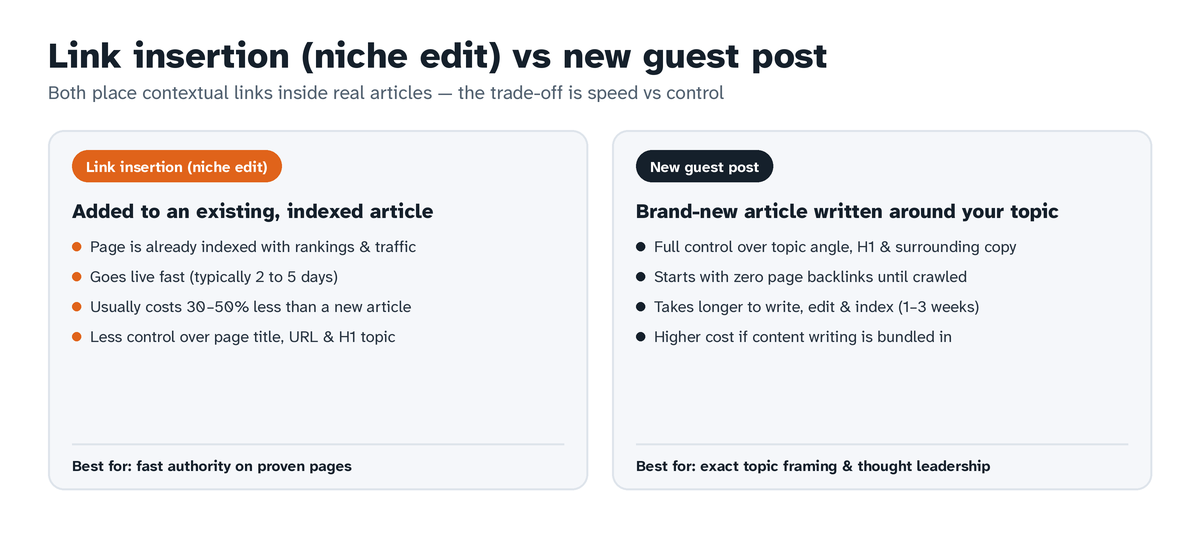
| Factor | Link insertion (niche edit) | New guest post |
|---|---|---|
| Google index status | Page is already indexed with known ranking history | Starts unindexed; may take days or weeks to crawl |
| Existing page strength | Inherits existing internal links, organic impressions & backlinks | Starts with zero external links unless promoted |
| Turnaround time | Typically 24 hours to 5 days | Typically 1 to 3 weeks (topic pitch + writing + review) |
| Typical market cost (2026) | 30%–50% lower than writing + publishing a new post | Higher because full article production & permanent feed slot are included |
| Control over topic & H1 | Limited to articles the site has already published | Full control over headline angle, subheadings & structure |
Simple rule of thumb: Use a link insertion when the partner blog already has a well-ranked guide on your exact subtopic and a short two-sentence addition makes that post genuinely more helpful. Write a new guest post (or run a content collaboration) when no existing page on their site fits naturally without forcing the context.
How much do link insertions actually cost in 2026?
Across public marketplace data and direct publisher quotes in October 2026, pricing splits sharply depending on whether you deal directly with website owners or buy through multi-layer resellers:
| Channel / site tier | Typical 2026 price per insertion | What drives the price |
|---|---|---|
| Direct link swap between two site owners | $0 cash (trade value for value) | Both sites have real Search Console clicks in adjacent niches |
| Niche indie blogs & micro-SaaS sites (DR 15–35, real clicks) | $25 – $95 direct ($60–$140 via brokers) | Owner places the edit directly without agency middleman margin |
| Established B2B / SaaS / consumer blogs (DR 35–55, 1k–15k monthly clicks) | $100 – $260 direct ($180–$380 via brokers) | Steady Google Search Console traffic + clean outbound link ratio |
| Recognizable industry publications (DR 60+, 20k+ monthly clicks) | $280 – $600+ | Strict editorial review, human referral clicks, brand trust |
Notice the spread between direct owner rates and broker packages. On open catalogs and managed outreach shops (which we benchmarked side by side in our review of the 10 best backlink marketplaces), deposit surcharges, payout cuts and agency markups regularly add 25% to 60% on top of what the publisher actually receives.
Seven red flags that separate clean insertions from spam
Before paying a dollar or trading a link, inspect the exact candidate URL against seven non-negotiable checks:
- Never buy from someone who refuses to prove domain ownership. A huge slice of ultra-cheap "curated niche edits" sold on forums are injected by rogue contributor accounts—or worse, compromised WordPress plugins—without the site owner's knowledge. Once the owner audits their site, those links get wiped overnight.
- Check Google Search Console clicks or organic keyword trends, not just DR. A DR 52 blog whose organic traffic plunged to zero after a Google core update is a liability, not a bargain.
- Inspect the exact URL in Google right now (
site:domain.com/exact-slug). An "aged post" that isn't even indexed in Google passes zero search equity. - Count outbound links already inside the article. If a 900-word post already stuffs nine external commercial links into every third paragraph ("best CRM", "best VPN", "best payroll software"), your link is sitting in a link farm.
- Never force awkward exact-match commercial anchors into unrelated sentences. Dropping "affordable emergency plumber Austin" inside an article about kitchen paint colors screams manipulation to both human editors and Google's SpamBrain classifier. Write 2–3 genuinely useful sentences around a natural partial-match or branded anchor instead.
- Confirm link attributes before sending money. Agree explicitly whether the placement is
Do-follow,SponsoredorNo-followso neither side feels misled after publication. - Verify that older posts keep their links rather than churning them every 90 days. Shady sellers sell 90-day edits disguised as "permanent" placements and strip old links out quarterly.
Three clean ways to get link insertions without cold spam
1. Trade direct insertions on relevant posts with verified site owners
If your own blog already publishes useful guides with real search impressions, you don't have to pay cash at all. On Swappsy's link exchange, you can verify ownership of up to 5 domains for free ($0/month, 30 monthly partner requests), filter real sites by niche and Search Console clicks, and agree on clean contextual placements where both editors control every word on their own site. Note that Swappsy focuses strictly on transparent two-way exchanges, content collaborations and listicle spots rather than blind ABC pools.
2. Buy directly from verified owners with 0% middleman commission
When your site is brand new or you don't want to add outbound swap links, Swappsy's backlink marketplace lists existing-article placements directly from verified domain owners starting at $10—with 0% platform commission on either side. You see the domain, Search Console clicks, turnaround and link duration upfront before paying the owner directly via PayPal or Wise.
3. Pitch specific paragraph additions to editors who already cover adjacent topics
When reaching out directly to a blog editor outside a platform, skip generic "how much for a niche edit?" emails (which go straight to spam folders). Reference the exact section of their existing guide, share one genuinely helpful data point or tool comparison missing from that section, and send the exact two sentences ready to paste:
Subject: Quick addition idea for your [Topic] guide?

Hi [First Name],

Was reading your breakdown on [Article Title] ([Exact URL])—especially the section covering [Specific H2 Topic].

We just published fresh data / a free calculator on [Specific Subtopic] ([Your URL]) that complements your point about [Specific Detail]. If you ever refresh that section, here's a clean two-sentence addition you're welcome to adapt:

"[Two natural, non-promotional sentences adding real context for their reader with natural anchor text.]"

Happy to return the favor in an upcoming piece on [Your Site] or cover your editorial update fee if you offer sponsored spots—just let me know what works for your team.

Best,
[Your Name]
Watch every insertion after it goes live
Because insertions live inside articles that editors periodically refresh, silent link loss is far more common on niche edits than most buyers realize. Every single placement should go straight into a dedicated watch-list tracker—see our guide on how to monitor backlinks. If an edit gets trimmed during a future update, jump on it the same week using the templates in our link reclamation guide.
Frequently asked questions
Are niche edits against Google's guidelines in 2026?
Paying cash or trading links purely to manipulate PageRank without qualifying links via rel="sponsored" or rel="nofollow" violates Google's link spam policy. What triggers algorithmic neutralization in practice is unnatural patterns: hacked sites, PBNs, irrelevant multi-niche blogs and forced commercial anchors. Editorial updates placed by the real site owner inside relevant, human-read articles behave like ordinary web publishing.
How long does it take for a link insertion to get recrawled by Google?
On active blogs with steady Search Console traffic, Googlebot typically recrawls updated articles within 3 to 14 days—much faster if the publisher also updates internal links or clicks "Request Indexing" inside their Search Console account.
Should I supply the surrounding paragraph text or let the publisher write it?
Always draft 2 to 3 natural sentences written in the exact tone of the host article so the editor has five minutes of work instead of thirty, while making clear they have full freedom to edit the wording for their audience.
Is it better to insert links near the top or bottom of an article?
Upper-to-middle body paragraphs related to the reader's core question get crawled reliably, earn actual human referral clicks, and survive future content trims far better than tacked-on sentences at the very bottom of a post.
How do I know if a seller quietly deleted my link insertion two months later?
Add every live insertion URL to Swappsy's free backlink monitor ($0/month up to 1,000 backlinks; daily checks on $4.99/month Pro and all Swappsy marketplace deals) so you get an email alert as soon as any page drops your link or adds nofollow.